Our History
1970s to 1990s
Rainbow Families Beginnings
In the 1970s in Washington DC, a group known as Gay Fathers was created for previously married gay dads to connect with one another and share resources. The group was loosely connected with other gay fathers groups in New York, Los Angeles and San Francisco, and after several years, the organization became the Gay Fathers Coalition.
Meanwhile, in 1981, Michele Zavos and her then-partner formed a Lesbian Moms Group (see her story, “Revolutionary & Different” here) with upwards of 50 women who gathered weekly to discuss conception, adoption, parenting ideas, safer schools for their kids, navigating extended family and more. This collective of education would soon become known as Maybe Baby and has been proudly trademarked for its uniqueness.
In 1984 the Gay Fathers Coalition became known as “Gay and Lesbian Parents Coalition” to include lesbian parents. As this grew, international chapters were formed in Canada, Europe and Australia and the name was again changed to “Gay and Lesbian Parents Coalition, International (GLPCI)”. This subsequently became the “Family Equality Council”.
As the same-sex parenting movement expanded its options with more families being formed through adoption and surrogacy, in 1988, the Washington DC chapter of this group branched off to become Rainbow Families DC led by Scott Davenport & Tim Fischer. As one of the most visible gay male couples with kids in the area, they had a desire to connect with other gay parents and meet some of the needs not filled by the other group. They created an AOL listserv, held social events at their home, local parks, skating rinks, etc. and shared resources of accepting schools, pediatricians, and service providers. This was among the first resources of its kind, with the mission to help gay parents connect and share information, especially as in those days, LGBT parenting was not openly supported – or even discussed.
*Information provided by James Fagelson, Board Member, 1985-1996
Late 1990s to Early 2000s
Whitman-Walker, Passing the Baton, and a Conference is Born
During this time, Washington DC’s Whitman-Walker Clinic (WWC) had a robust Lesbian Services Program. Ellen Kahn, Director of the program (and having had her first child with her partner in 1999) worked to expand LGBT family programs at WWC including advocacy, parent groups, and outreach to pediatricians, fertility clinics, and adoption agencies. The lesbian parents group formed by Michele Zavos became part of this program.
This is also where the Maybe Baby classes became more structured. And, as a greater number of men were starting families, primarily through surrogacy and international adoption, demand grew for a men’s Maybe Baby class as well.
As Scott & Tim’s children got older, they wanted to step down but keep RFDC going. They spoke with Ellen to discuss passing the baton to her under WWC. With WWC’s leadership and support, Rainbow Families DC became a part of their Lesbian Services Program. The AOL listserv, the embodiment of RFDC, was passed onto its new home at WWC.
In 2003, RFDC held its first Family Gathering with Aimee Gelnaw of Family Pride Coalition (now Family Equality Council) at Takoma Park Middle School in Takoma Park Maryland. This would be the first Rainbow Families Conference and would become an annual program.
2005 to 2008
Visit Facilitator SiteA New Organization Forms
In 2005, WWC was transitioning to a federally-qualified health center, which brought about certain challenges – for example, non-reimbursable services would be stripped out including most of Lesbian Services and all of RFDC. At that time, Ellen left WWC to work for the Human Rights Campaign, where she sought and received approval from WWC’s leadership to move RFDC and its associated programming with Ellen.
Having done so, Ellen then established RFDC as its own nonprofit entity – and would become one of a few lesbian and gay parent groups in the country.
The first board was established and despite growing pains, the board worked tirelessly to get RFDC to function as a nonprofit. They adopted by-laws and pursued non-profit status. RFDC had no staff and was completely volunteer led, and held many programs still part of today’s Rainbow Families. At this time, programs such as Maybe Baby were officially handed over to Rainbow Families to own and maintain.
In 2007, RFDC transitioned from the AOL listserv to a new membership platform – a significant step for the organization.
In June 2008, RFDC received its official nonprofit status as a 501(c)3 organization.
2009 to 2013
Establishing Rainbow Families
During these years, RFDC continued to operate the programming it had become known in the community and region for – the Annual Conference, support groups, Maybe Baby classes and social gatherings. RFDC became increasingly organized in our operation, including offering consistent, high quality programming, stable financials and processes.
In 2011, the volunteer Board sought out a new platform to provide the organization with a website and interactive functionality for members, plus handle administrative needs. It was at this time RFDC was branded with a new tree logo, which would become a registered trademark of the organization.
RFDC established some larger social events that evolved into annual programming. These events were the product of Board member’s visions. The Family Dance grew out of Ellen Kahn’s experience at a non-RFDC local Family Dance (at the Washington Ethical Society) and the recognition of a desire among LGBT families for such an event. RFDC’s Annual Visit to Cox Farms was initiated by Renee Bradley in recognition of the need for more events in Virginia and knowing Cox Farms had been an LGBT-inclusive leader in the region. Our Family Camping Weekend was implemented after Richard Gervase was inspired after learning about weekend getaways held by other larger nonprofits.
In addition to the RFDC initiated events, RFDC developed community partnerships to offer more events for LGBT families in Washington DC region. The Family Picnic at Hillwood Estates began after Hillwood reached out to RFDC and has been a valued tradition ever since. Other organizations would recognize the celebratory nature of our gatherings and offer to host or sponsor events.
2014 to Present
Transition, Opportunity, Growth
2014 was a year of transition. Key board members – Ellen Kahn, Renee Bradley and Rocky Galloway – decided to step off the board. Our long-serving part time staffer, Jen Riesch, also announced her retirement. The Board vetted a number of new Board members, and redefined the role and responsibilities of the organization.
In May 2015, RFDC welcomed six new board members, elected a new Board President, and hired a new part time staff person. At this time, the “DC” moniker was removed to ensure that LGBTQ+ community members in DC/Maryland/Virginia would know our services and programs were available.
In June 2018, Rainbow Families hired its first full-time Executive Director, Darren Vance. Darren and the Board worked to expand our reach into greater and more diverse areas, plus add more advocacy, education, and events. Another initiative was to expand our services, to not only LGBTQ headed families, but all LGBTQ+ families.
At this time Rainbow Families trademarked the Rainbow Families name, the ‘tree’ logo, and the Maybe Baby program.
In March of 2020, with the onset of the devastating Covid-19 pandemic, all Rainbow Families programs moved online. This included our first ever Virtual Family Conference – we were the first LGBTQ organization to take this risky leap forward. It paid off. We saw our largest attendance, and were able to now reach families across the country. This national attention, related requests for our unique services, and increased talent with managing virtual programs, will remain an important element of Rainbow Families – even as we get back to in-person events.
By January of 2021, Rainbow Families was reaching an average of 10,000 family members each month, through our membership and various communications channels.
A Look Back: Family Building in the 1980s
“Everything We Did Felt Revolutionary & Different”
By Michele Zavos
It was 1981 and my then partner, Libby Leader, and I, had just turned 30. Somehow our biological clocks took over and we began talking about having a child together. Before then both of us had thought we wouldn’t have kids because we were worried about what it would mean as lesbians to raise children. Would it be fair to them? How hard would it be for them? Did we have the right to raise children? This was 1981 after all. We didn’t know anyone who had had children as lesbians. Sure, we knew women who had children in straight relationships and later came out, but no one who decided, as a lesbian, to have a child.
And, this being 1981, everything we did or thought was political. We had groups for everything – Jewish lesbian groups, communist groups, socialist groups. So, one day I looked at Libby and said, “Let’s start a group!” We knew we had lots of questions about having kids, political questions, how to questions, were we ready questions, did we really want to do this questions.
So, we put the word out, and pretty soon we had 50 women in the basement of our Brookland home talking about having kids. Over the next few months that group distilled down to about 20 women. We met every other Tuesday for over 10 years, I think. We talked about everything – whether it was appropriate to have a “known” donor, was that mimicking the straight world, shouldn’t we all adopt, where should we adopt from, what was the meaning of gender, how should we dress our kids, what toys should we give them, was there a fertility center that would give sperm to a single woman, much less a lesbian, if we used a known donor, what about AIDS, what should our kids call us, what last names should we use, was any of this important? You can talk about a lot of things every other Tuesday for over 10 years.
Eventually the women who stayed in the group all had children. Of course those who decided not to have children dropped out. Our kids came to us in many ways – unknown donors, known donors, domestic adoption, adoptions from Latin American countries.
We even had the first “Family Week’ in Provincetown. Our whole group and our kids went to Provincetown for a week. Parts of the trip were wonderful, and parts were a disaster. Everyone had strong opinions about parenting by that time, and few of us were shy about expressing them. We were like this big extended family, warts and all.
There weren’t LGBT caucuses or GSAs in schools, schools didn’t reach out to our community. The Director at one school where a number of our children applied told us that the school had “lots of children with problems” when she explained that the school could deal better with lesbian parents. Interestingly, none of our children were accepted into that school, which now has a strong gay families contingent.
Everything we did felt revolutionary and different. Meeting with teachers every year to explain our families, telling our kids that we were their real parents when they were teased at school, discussing all of this with our group. While we were raising our kids, we were raising ourselves as lesbian parents.
Later, the Whitman-Walker Clinic Lesbian Services Program started Maybe Baby groups (thanks to trailblazers like Ellen Kahn who also got Rainbow Families DC to branch out on their own) . Gay men started having children together. Fertility centers welcomed lesbian parents. Couples could jointly adopt. Laws changed. And now my daughter is an adult. When she was about 17, she told me that she had something important to tell me. She said she was straight, and it wasn’t my fault. Attitudes have changed too.
Note: Michele Zavos received Rainbow Families first “Hero of the Year” Award for her contributions spanning 40 years to our community, and to Rainbow Families.
"One of the most important things about our group was the support our kids found in each other. And for the adults, as well."
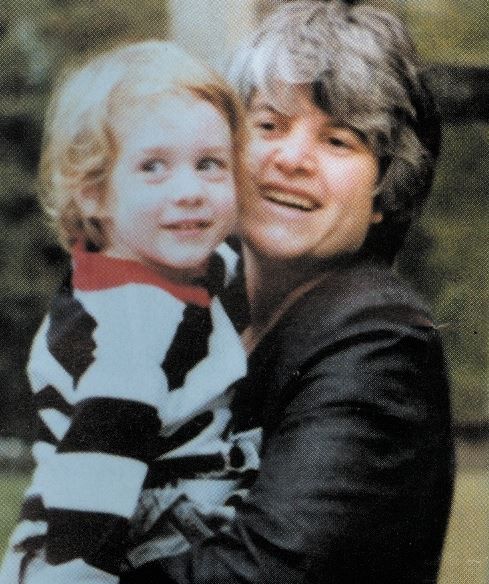
Pictured: Author Michele Zavos with her daughter Addie.